
Get detailed feedback on your UPSC answers in minutes—not days
Specific, honest, actionable - like a senior mentor sitting with your answer. Not ChatGPT. Calibrated against actual topper patterns.
Used by serious Mains aspirants
What students face today
How it works
Step 1
Paste your answer or upload your handwritten sheet
Step 2
Our AI mentor evaluates it against UPSC topper patterns
Step 3
Get specific improvements with the rewritten version
Sample Evaluation
See exactly what your feedback looks like
This is a real answer from a UPSC aspirant, evaluated by our AI mentor.
(a) Explore how persuasion impacts public opinion and fosters social change. (150 Words) 10 marks (b) Explain the difference between probity and integrity, using relevant examples. Suggest measures to ensure probity in governance. (150 Words) 10 marks
WHAT YOU DID WELL
There are two genuinely usable instincts in this answer. First, the Satyendra Dubey example in Q(b) is placed in the right conceptual bucket: it shows probity as active resistance to institutional corruption, not just personal honesty. Second, Raja Ram Mohan Roy is a relevant example for persuasion leading to social change. These are the places where your answer begins to look like a GS4 answer rather than a general essay. The raw material is present; the scoring loss is happening because the material is not being converted into syllabus language, frameworks, and institutional anchors.
HONEST ASSESSMENT
This paper scores approximately 8.5/20. The honest diagnosis: you know the topic, but you are not yet writing in the examiner's scoring language. Q(a) is not asking for random positive and negative impacts of persuasion; it is a Chapter 3 Attitude question asking how persuasion works through cognitive, affective, and behavioural components. Q(b) is not asking for a moral paragraph on integrity; it is asking for a distinction plus governance mechanisms. In UPSC terms, the answer currently says 'I have read about the issue.' It needs to say 'I know the syllabus framework, I can apply it, and I can anchor it in institutions.' That shift alone can move this answer from 8.5/20 toward 13-14/20.
BEFORE YOUR NEXT ANSWER
Before writing your next GS4 answer, pause for 20 seconds and write the scoring frame on your rough sheet. For persuasion/attitude: cognitive component | affective component | behavioural component. For probity/governance: law | institution | conduct rule | ethical principle. Then force each body point to carry one framework word and one named example. This prevents the answer from becoming a good-looking but low-scoring general studies response.
Several words in this answer were misread by the OCR scanner: 'right' appeared as 'eight' in the C.S. Lewis quote, 'wielded' as 'yiedled', 'changes' as 'charges', 'bribe' as 'buise', and 'reported' as 'exported'. None of these have been treated as student errors — they are OCR artifacts. If any feedback feels inaccurate to what you actually wrote, re-upload with a clearer, well-lit image.
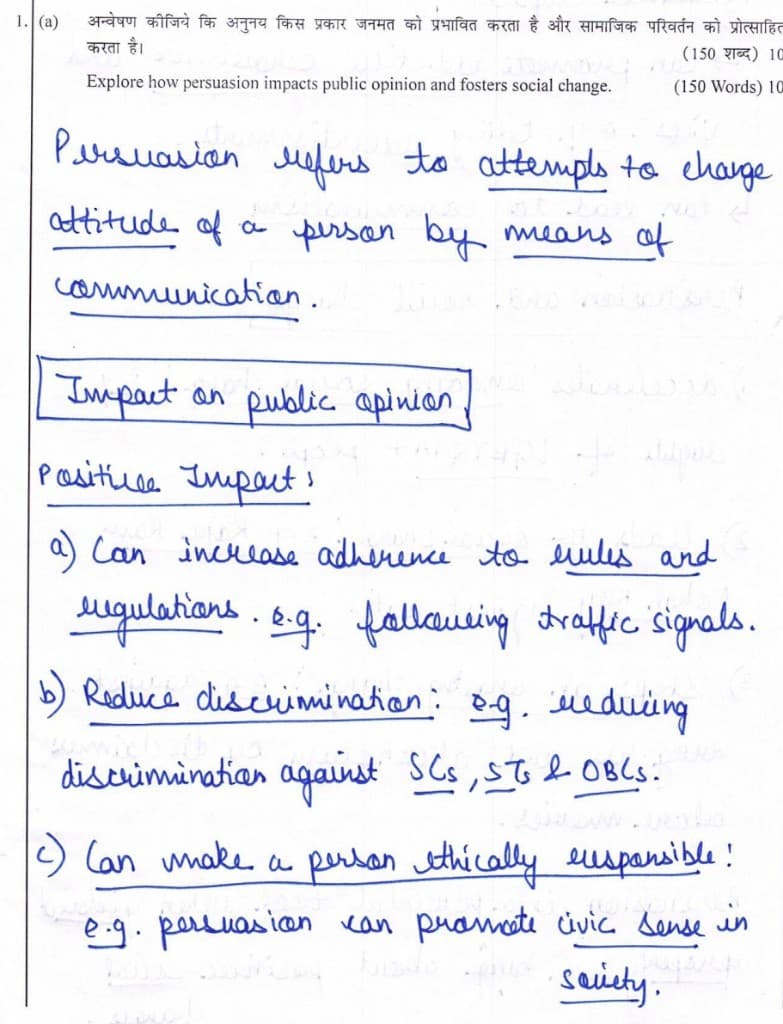
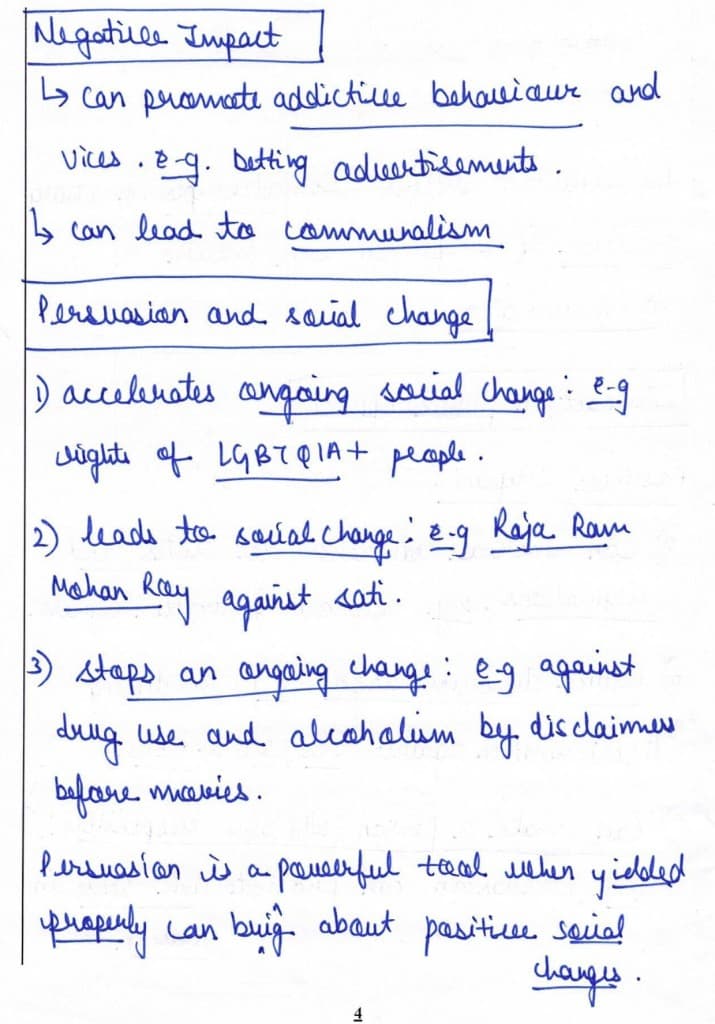
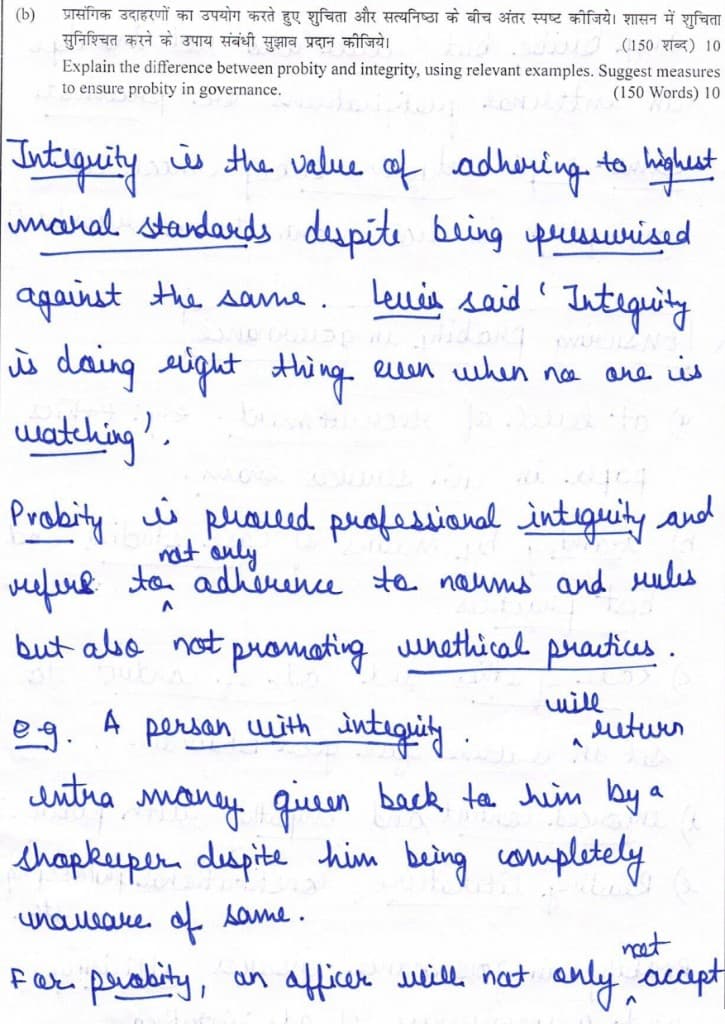
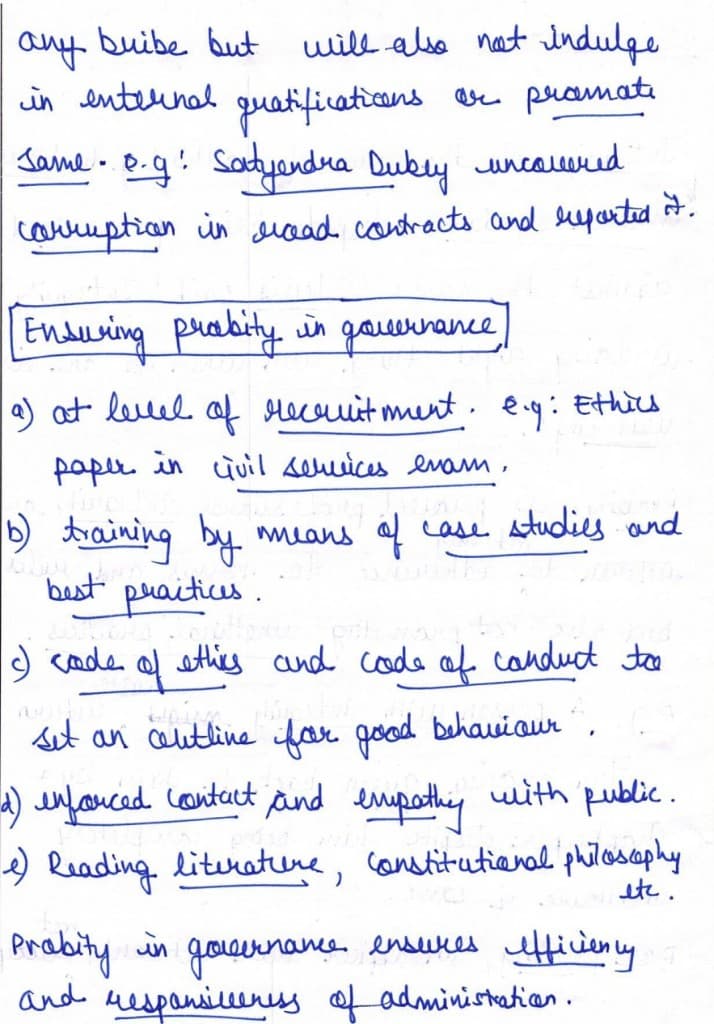
Several words in this answer were misread by the OCR scanner: 'right' appeared as 'eight' in the C.S. Lewis quote, 'wielded' as 'yiedled', 'changes' as 'charges', 'bribe' as 'buise', and 'reported' as 'exported'. None of these have been treated as student errors — they are OCR artifacts. If any feedback feels inaccurate to what you actually wrote, re-upload with a clearer, well-lit image.
How to use this feedback: “Write this instead” is a guidance template, not a copy-paste final answer. Adapt it to your own structure and ensure your final response stays within the expected word limit for the marks asked.
≈ +2.5 marks
Q(a) describes WHERE persuasion has been used but not HOW it works. Add the Chapter 3 mechanism — cognitive, affective, behavioural — and this becomes a syllabus answer instead of a general-awareness answer.
Q(a) — Positive Impact section, points a, b, c
YOU WROTE
Can increase adherence to rules and regulations. e.g. following traffic signals.
WRITE THIS INSTEAD
Mechanisms of Persuasion: 1. Cognitive route: persuasion through evidence and reason — e.g. RTI awareness campaigns shifted public belief about the right to demand government accountability, altering the cognitive component of citizen attitude. 2. Affective route: emotional appeals and moral authori...
Adapt this to your answer; do not paste it blindly. Keep the final word count aligned with the question's marks.
≈ +1.5 marks
Add one analytical paragraph on persuasion versus propaganda. This is what separates a GS4 answer from a list of examples and shows maturity on ethics, autonomy, and democratic consent.
Q(a) — missing third subheading after Persuasion and Social Change
YOU WROTE
Persuasion is a powerful tool when wielded properly can bring about positive social changes.
WRITE THIS INSTEAD
Risk — When Persuasion Becomes Propaganda: 4. Persuasion respects individual autonomy and invites rational consent; propaganda bypasses it through disinformation and emotional manipulation — a distinction Aristotle drew between Logos (reasoned argument) and manipulation of Pathos (manufactured emoti...
Adapt this to your answer; do not paste it blindly. Keep the final word count aligned with the question's marks.
≈ +0.5 marks
Use a two-column Integrity vs Probity table. It communicates the distinction faster, looks examiner-friendly, and frees words for the measures section where marks are waiting.
Q(b) — the distinction section between introduction and measures subheading
YOU WROTE
Integrity is the value of adhering to highest moral standards despite being pressurised against the same.
WRITE THIS INSTEAD
Draw a 2-column table: | Dimension | INTEGRITY | PROBITY | |---|---|---| | Nature | Individual moral virtue — adhering to highest standards under pressure | Professional standard — active resistance to institutional unethical practice | | Scope | Personal behaviour and character | Systemic conduct a...
Adapt this to your answer; do not paste it blindly. Keep the final word count aligned with the question's marks.
≈ +2 marks
Q(b)'s measures section needs named governance instruments. Replace fragment labels with RTI Act, Lokpal, Nolan Principles, Second ARC, and CCS Conduct Rules so the examiner can award concrete ethics-governance marks.
Q(b) — Ensuring Probity in Governance section, points a through e
YOU WROTE
a) at level of recruitment. e.g: Ethics paper in civil services exam. b) training by means of case studies and best practices. c) code of ethics and code of conduct to set an outline for good behaviour.
WRITE THIS INSTEAD
Ensuring Probity in Governance: 1. Legislative accountability: RTI Act (2005) empowers citizens to demand transparency from public servants, deterring corrupt practices through sunlight as disinfectant. 2. Institutional oversight: Lokpal and Lokayuktas Act (2013) provides an independent ombudsman me...
Adapt this to your answer; do not paste it blindly. Keep the final word count aligned with the question's marks.
≈ +1 mark
Rewrite the conclusions with ethics vocabulary and constitutional/public-trust language. The final line is the examiner's last impression; do not spend it on a generic sentence.
Q(a) and Q(b) conclusions
YOU WROTE
Probity in governance ensures efficiency and responsiveness of administration.
WRITE THIS INSTEAD
Q(b) conclusion: 'Probity — as the Nolan Committee (1994) defined across seven principles including selflessness, accountability, and openness — is not merely a governance standard but the ethical foundation on which public trust and democratic legitimacy rest. As the Second ARC observed, an ethical...
Adapt this to your answer; do not paste it blindly. Keep the final word count aligned with the question's marks.
✏️ Draw this diagram
hub-and-spokeCentral node: PERSUASION. Three spokes outward: (1) Cognitive Route → evidence/reason → RTI awareness campaigns; (2) Affective Route → emotional appeal/moral authority → Gandhi's satyagraha; (3) Behavioural Route → social norming → Swachh Bharat ODF status. One additional spoke pointing downward: RISK: Propaganda → manufactured consent (Chomsky). Place after the introduction definition, before the body points.
Place: After introduction, before Mechanisms of Persuasion subheading • 90 seconds • approximately +1 mark
Highest ROI fixes
Recoverable marks at a glance
≈ +7.5 marks still on the table
Q(a) describes WHERE persuasion has been used but not HOW it works. Add the Chapter 3 mechanism — cognitive, affective, behavioural — and this becomes a syllabus answer instead of a general-awareness answer.
Do this: Add the missing syllabus language, named example, or legal anchor.
Q(a) — Positive Impact section, points a, b, c
Q(b)'s measures section needs named governance instruments. Replace fragment labels with RTI Act, Lokpal, Nolan Principles, Second ARC, and CCS Conduct Rules so the examiner can award concrete ethics-governance marks.
Do this: Add the missing syllabus language, named example, or legal anchor.
Q(b) — Ensuring Probity in Governance section, points a through e
Add one analytical paragraph on persuasion versus propaganda. This is what separates a GS4 answer from a list of examples and shows maturity on ethics, autonomy, and democratic consent.
Do this: Add the missing syllabus language, named example, or legal anchor.
Q(a) — missing third subheading after Persuasion and Social Change
Rewrite the conclusions with ethics vocabulary and constitutional/public-trust language. The final line is the examiner's last impression; do not spend it on a generic sentence.
Do this: Replace the low-impact sentence with an examiner-facing line.
Q(a) and Q(b) conclusions
Use a two-column Integrity vs Probity table. It communicates the distinction faster, looks examiner-friendly, and frees words for the measures section where marks are waiting.
Do this: Change the presentation format before adding more content.
Q(b) — the distinction section between introduction and measures subheading
Exam-day reading: fix the first two and this answer stops looking generic.
The score jump is not from writing more. It comes from making the examiner see the syllabus framework, named instruments, and conclusion quality within the first scan.
↑ This is a real answer evaluated by Avyayhh. Scroll through the answer on the left. Click highlighted text to jump to the specific feedback on the right.
Plans & credits
Subscriptions and one-time packs bill in usage credits. Exact checkout is on the way.
Secure checkout with Razorpay (UPI, cards, netbanking) is coming soon. You’ll confirm plans and add-ons from Settings.
Get started
Free
₹0
to start
500 usage credits when you sign up — enough to try typed answers and a few uploads.
- ·Usage-based credits (fair billing by length and scan size)
- ·GS + Essay-style evaluations with verbatim rewrites
- ·History of your submissions
Starter
₹99
one-time
~4 typical answers (varies by length)
One-time credit pack — roughly four typical answer evaluations, depending on length.
- ·Credits added to your balance
- ·Use across typed and upload paths
- ·Does not renew
Monthly subscriptions
Essential
₹250
per month
~15 typical answers / month (varies by answer size)
Roughly fifteen typical answers per month in credits.
Subscribe when checkout opensPlus
Popular₹499
per month
~35 typical answers / month (varies by answer size)
Roughly thirty-five typical answers per month in credits.
Subscribe when checkout opensIntensive
₹599
per month
~45 typical answers / month (varies by answer size)
Roughly forty-five typical answers per month in credits.
Subscribe when checkout opensAdd-on credits
₹30 per 100 credits
Top up any time once checkout is live. Choose the amount you need.
Create accountHow credits work
Fair usage billing: about 1000 words ≈ 100 credits for typed or English OCR; Hindi or mixed scans use page-based credits. You are charged only after a successful evaluation.
Contact us
For product questions, pilot interest, or anything that is not working as expected, email us—we read every message.